I'm interested in understanding how life works from a physics perspective. To achieve that, I create computational, statistical and mathematical models that let us understand experimental data in novel and creative ways.
Computational biology
I have a physicist mindset, and I like to think in terms of models and first principles from which the rest emerges. This is how I have created computational models for different omics (spanning from
genomics to proteomics), and their associated software to allow non-bioinformatics specialised researchers to use them. Some of them have a community of researchers around them that, after twelve years, keep being used, developed and cited. For example, in the period 2014-2018, while I worked in my PhD at CNIC (Madrid), the three publications related to SanXoT, the Systems Biology Triangle model, and the statistical model behind (see the Publications section), have been cited 52 times only in 2025, and have been complemented with new tools after I left, such as iSanXoT and PTM-compass. Today, I apply AI and machine learning to create new models that bring up what is important in messy datasets.
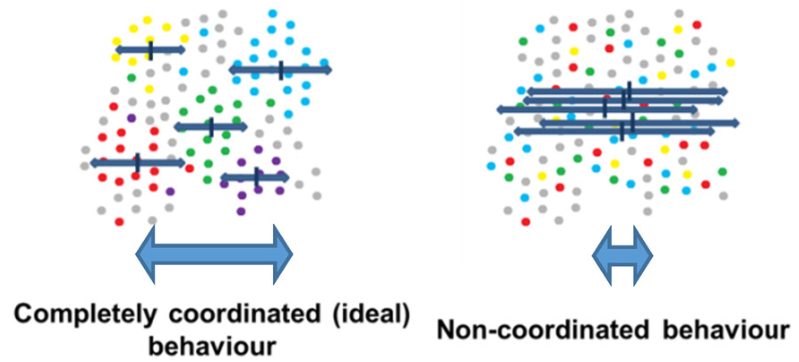
I'm especially interested in making interpretable the incredibly intricate patterns of biology. For example, I created the Systems Biology Triangle, which is a systems biology model created especially for
proteomics data structures. The model introduces the concept of protein coordination. In proteomics, information flows from spectra to proteins, protein complexes and functional pathways, following workflows that are very different from genomics or transcriptomics (in which the basis are sequences rather than spectra). When I started to work in proteomics, many researchers recycled models built for genomics and transcriptomics (such as GSEA and over-representation algorithms), which is not wrong, but don't use all the potential that proteomics datasets offer. Building on the WSPP model, I created an entirely new systems biology model that puts proteomics data structures at the centre. After ten years, my 2016 paper has been cited eleven times only in 2026, helping research ranging from embryonic brain angiogenesis to heart failure induced by cancer therapy.
systems biologygene enrichment analysisgene over-expression analysis
Omics technologies
I'm fascinated by the complexity of life. Since childhood, I have always been interested in the big picture of how life is organised. That's why, after completing my PhD in bioinformatics applied to proteomics, I decided to
get out of the comfort zone and move to Newcastle University to work in other areas of computational biology, to broaden my understanding. Today, my models and research are being applied to genomics, epigenomics (such as ChIP-seq and histone marks), and transcriptomics (including both bulk RNA-seq and single cell RNA-seq). On the way, I had the joy of learning and working in the immune system, mitochondrial research, differences between men and women, evolution, kidney disease, ageing, and cardiovascular disease.
The algorithm now supports permutation-based significance testing for its prominence index. Because it is
computationally intensive, this option is available only in the command-line version, but the results can be viewed and filtered in the web application if they are in the output tables. A preprint and GitHub release are coming soon; meanwhile, email me to try it.
Translophagy paper published in FEBS Letters
Our collaborative paper in FEBS Letters proposes translophagy, a mechanism through which autophagy may protect the fidelity of protein synthesis by clearing damaged translational machinery. I contributed bioinformatics supervision for the proteomics datasets and analyses, including reconstructing and documenting the underlying computational workflow.
ELTE lectures delivered in Budapest
I delivered three lectures on epigenomics and single-cell RNA-seq for the Analysis of Omics Data PR summer course at ELTE, Budapest. I especially enjoyed the students' participation, questions and engagement throughout the sessions.
Run Onsager analyses directly from the website
The Onsager viewer can now run a fresh Onsager analysis directly from DESeq2 result files and a selected gene set library. If you have suitable RNA-seq contrasts, try it with your own files! Load the outputs into the viewer and let us know how it went.
Onsager viewer launched
I launched the Onsager viewer on this website, an interactive way to visualise data from the Onsager prominence model. It includes an infographic about it, in case you are curious!
TrevixLab.org is online!
I launched TrevixLab.org as my personal research website, I hope you enjoy it!
Current lab context
I currently work at Newcastle University as a Research Associate at Professor Gavin Richardson's group about cardiovascular senescence and regeneration, within the Biosciences Institute.
Richardson lab
At Richardson's lab we study how cellular senescence, regeneration and ageing shape cardiovascular disease, especially myocardial ageing and heart repair. We investigate disease mechanisms and therapeutic opportunities within Newcastle University’s Vascular Medicine and Biology theme. The lab provides a fertile and stimulating collaborative environment where I can test and develop my models.
cardiovascular ageingsenescenceomics data
My contribution
I contribute to Richardson's lab by developing statistical analyses, computational models, AI approaches, and mathematical frameworks to enhance experimental design, support biological interpretation, and extract mechanistic insight from complex biological datasets. I am currently developing a statistical model (and its associated software) to understand the impact of disease and ageing in biological processes, and the effectiveness of treatments (have a look!).
Alongside publications, I contribute to research by originating computational methods and software, enabling their use and development by other researchers, and sharing expertise through collaboration and teaching. These activities provide a broader view of how I contribute to computational research and to the communities that use it.
Methodological leadership
I co-developed the
Systems Biology Triangle (SBT),
an established proteomics-native framework for analysing coordinated protein responses in pairwise quantitative experiments. Combined WSPP–SBT workflows retain the hierarchy linking spectra, peptides, proteins and functional categories, rather than beginning with a flattened protein-level table. This data-aware approach also guides the
current transcriptomics work
described under Projects.
systems biologyquantitative proteomicsstatistical modelling
Public indicator:
SBT remains an operational model in the current
iSanXoT platform,
where it is provided as a dedicated module and embedded in reusable compound WSPP–SBT workflows.
Open software and a growing ecosystem
SanXoT has developed beyond the original package into a wider ecosystem of users, developers and connected tools. After my direct involvement ended, researchers at CNIC carried the framework forward through iSanXoT and added resources for database construction, reporting and specialised proteomics workflows. The public code and release history trace how that analytical environment has continued to evolve.
research softwarebioinformatics workflowssoftware development
Teaching and knowledge exchange are part of my research contribution. I have developed and delivered practical bioinformatics training across universities and European programmes, connecting computational methods with biological interpretation. The emphasis is on helping learners move from omics data to reproducible analysis and on producing materials that remain useful beyond a single teaching session.
Public indicator:
Institutional course pages and a public teaching repository document these contributions; the
Teaching section
brings the roles, evidence and materials together.
Scientific trajectory
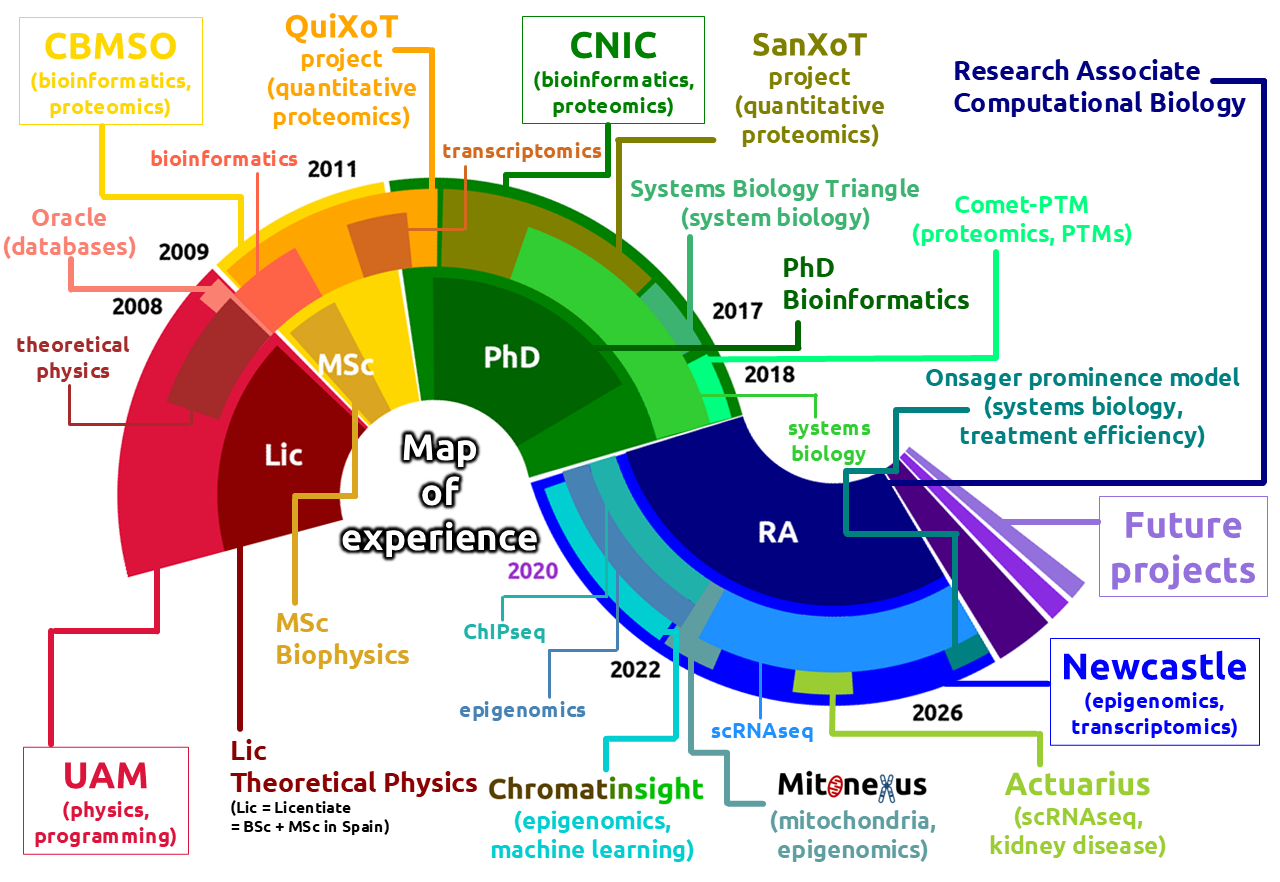
My scientific path has taken me from physics and biophysics into bioinformatics, systems biology, multiomics and single-cell analysis. I created the interactive map below to make more fun navigating my experience journey.
An interactive, visual map of my path from physics to computational biology. Click or tap on the ring sectors to get to know what they are, or switch to the messy static image if information overload is not an issue for you. (If your browser doesn't support JavaScript, you will only see the messy static image)
By the way, if you like this way to present your career path, just ask me, I had some fun creating a Python script that converts a boring table with career data into this JavaScript widget.
Projects
Here are some project seeds at different stages of development.
Computational epigenomics and machine learning approaches to understand chromatin structure, regulatory architecture and disease-associated genome function. A first model of Chromatinsight is on GitHub if you want to have a look. It was originally developed to detect differential epigenomic patterns between men and women, but can be used between any two groups of samples (provided that there are enough samples to have some statistical power). It was developed during my postdoc with Daniel Rico, while we both were at Newcastle University.
AIchromatin architecturegene regulationChIP-seqepigenomicshistone marks
Why this matters: It aims to find hidden differential pattens between epigenomic experiments, helping with interpretation.
Mitonexus is a project seed I conceived and developed to investigate how healthy and pathogenic mitochondrial DNA variants may influence epigenomic patterns in the nucleus, combining machine-learning models such as Chromatinsight with statistical physics. Preliminary data for healthy mtDNA variants for this project were analysed during my time at the former Wellcome Trust Centre for Mitochondrial Research, with related researchers and activities now under Newcastle University's Mitochondrial Research Group. A BBSRC Discovery Fellowship application based on Mitonexus received seven positive expert peer reviews and was subsequently shortlisted. I intend to pursue Mitonexus as a future research programme.
Why this matters: I aim to explain how mitochondrial variation influences nuclear regulation and contributes to health or disease.
Selected peer-review comment:«Understanding the effects of mitochondria on the nuclear genome and epigenome may have wide ranging biological ramifications» - Anonymous expert peer reviewer, BBSRC Discovery Fellowship application
At Prof Richardson's Cardiovascular Regeneration and Ageing Lab, I'm currently developing what we call the Onsager prominence model, a statistical model (and its associated software) for experiments that include three groups of samples: control, condition, and condition + treatment. In these experiments, understanding how effective a treatment is, or the side effects, can be difficult if only pairwise comparisons are performed: a treatment can rescue some pathways, while making others worse. The Onsager prominence model aims to make it easier to interpret the effect of treatment on each gene set. The model is still in alpha stage, but the viewer and the demo dataset are already available.
Why this matters: It helps reveal which biological processes a treatment restores, and which get worse due to it.
Teaching
Since 2009, I have taught bioinformatics and computational biology through proteomics lectures at the Universidad Francisco de Vitoria and the Universidad Autónoma de Madrid, undergraduate and postgraduate modules in proteomics and bioinformatics at Newcastle University, and, in 2026, practical omics sessions delivered with Eötvös Loránd University (ELTE, Budapest) and CHARM-EU. Alongside these lectures, I have supervised one student through CNIC's Cicerone programme and five MSc/MRes research students at Newcastle University; two of those projects led to peer-reviewed publications on which the students were first or joint-first authors. I have also provided sustained research mentoring to two PhD students, complementing their formal supervisory arrangements.
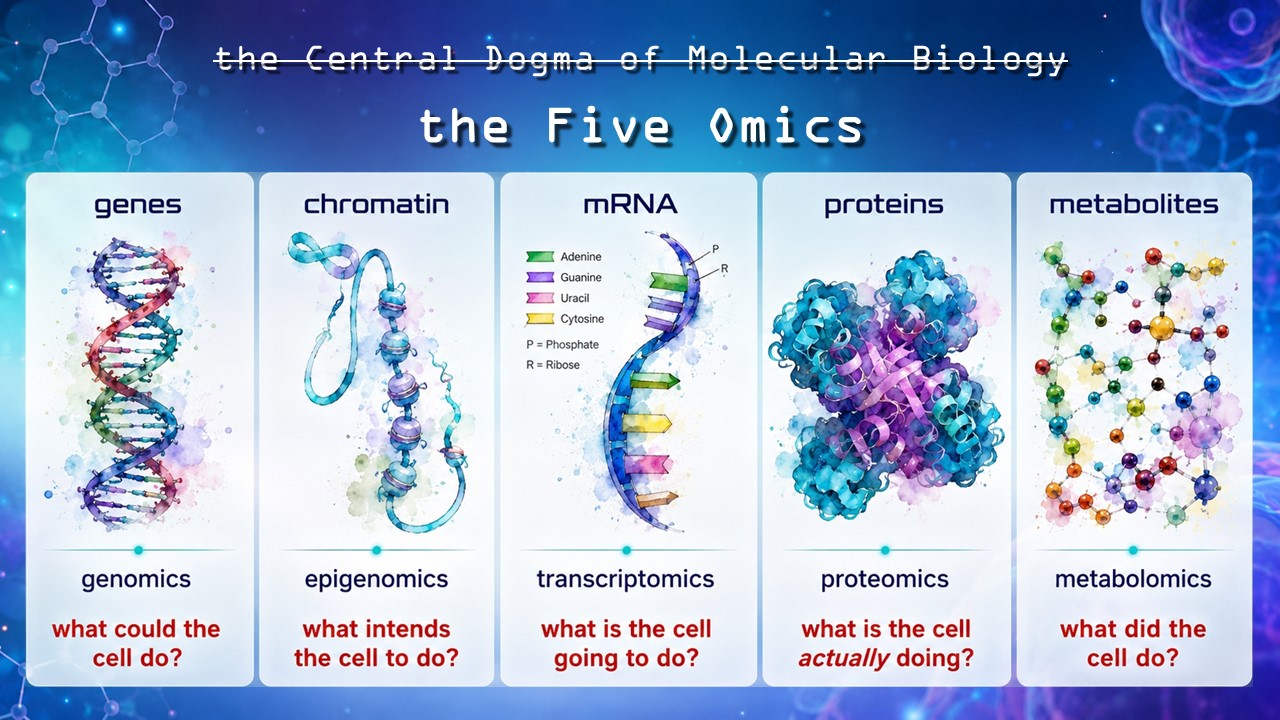
I love to use this slide to illustrate that the famous Central Dogma of Molecular Biology is an oversimplification.
Information in life goes from DNA to mRNA (transcription) and then to protein (translation), true, but in the real world it also goes in the opposite way, sometimes skips layers, and there are more layers. I use this visual to introduce the five main omics layers: genomics, epigenomics, transcriptomics, proteomics and metabolomics... Which is also an oversimplification (no hint to post-translational modifications, or DNA methylation, or more stuff, much more... you name it), but a less simple oversimplification than the previous one!
ELTE · Analysis of Omics Data PR
On 14jul-2026, I delivered three lectures for ELTE's practice-oriented
Analysis of Omics Data PR
summer course, covering ChIP-seq analysis and single-cell RNA-seq. The course trained students to move from high-throughput omics data to reproducible analysis, visualisation and biological interpretation, and I greatly enjoyed their participation and engagement during the sessions.
bioinformatics trainingChIP-seqsingle-cell RNA-seqomics data analysis
CHARM-EU · transnational teaching
I previously contributed 12 hours of lectures to the CHARM-EU transnational version of
Analysis of Omics Data PR,
delivered by ELTE. The course covers high-throughput data handling, processing and visualisation across genomics, ChIP-seq, transcriptomics, functional enrichment, metagenomics and proteomics.
higher educationbioinformatics trainingreproducible research
Open course materials
The practical materials are available through the
ELTEbioinformatics GitHub repository,
supporting reproducible learning with modules on Linux/Bash, next-generation sequencing, genomics, proteomics, transcriptomics, ChIP-seq, functional enrichment and single-cell transcriptomics.
open educational resourcesreproducible research
Selected publications
This is a selection of papers that are in the Pareto front in the freshness vs impact space - or, in other words, a healthy mix of recent and influential papers I authored or co-authored.
Translophagy - A potential link between autophagy impairment and translational errors.
Mykola V. Korolchuk, […], Marco Trevisan-Herraz, et al. · FEBS Letters · 2026
This is a collaboration exploring how autophagy may preserve translational fidelity. I provided bioinformatics supervision for the proteomics datasets and analyses, reconstructing and documenting the original computational workflow so it could be reported clearly and reproducibly. DOI:10.1002/1873-3468.70448
Urinary renal epithelial cells for NPHP1 phenotyping and personalized therapeutic response.
Praveen Dhondurao Sudhindar, […], Marco Trevisan-Herraz, et al. · Journal of Cell Science · 2025
This is a collaboration in which Dr Dhondurao Sudhindar developed patient-derived kidney cell models for NPHP1 disease, and I helped interpret complex multi-omics data. DOI:10.1242/jcs.264141
Evolutionary analysis of gene ages across TADs associates chromatin topology with whole-genome duplications.
Marco Trevisan-Herraz, Caelinn James, David Juan and Daniel Rico · Cell Reports · 2024
In this article we discovered that the evolutionary age of genes relates to 3D genome organisation, linking chromatin topology with whole-genome duplication history. DOI:10.1016/j.celrep.2024.113895
SanXoT: a modular and versatile package for the quantitative analysis of high-throughput proteomics experiments.
Trevisan-Herraz M. et al. · Bioinformatics · 2018
Here I presented SanXoT, a modular software package I developed to apply my previously published statistical models to quantitative proteomics. Together with the models on which it is based, SanXoT remains actively used and cited, and other researchers have developed tools to complement it, such as iSanXoT and PTM-compass. DOI:10.1093/bioinformatics/bty815
A novel systems-biology algorithm for the analysis of coordinated protein responses using quantitative proteomics.
Trevisan-Herraz M. et al. · Molecular & Cellular Proteomics · 2016
During my PhD at CNIC, I developed this novel systems-biology method dedicated to proteomics data (most models at the time were recycling algorithms for transcriptomics) to reveal coordinated protein responses, turning large proteomics tables into interpretable biological patterns. This is my third most cited paper, and after ten years is still in good shape (with 16 citations in 2025 alone). DOI:10.1074/mcp.M115.055905
General Statistical Framework for Quantitative Proteomics by Stable Isotope Labeling.
Trevisan-Herraz M. et al. · Journal of Proteome Research · 2014
Here, during my PhD at CNIC, I developed the statistical framework behind our quantitative proteomics pipeline, helping compare labelled samples and estimate protein changes more reliably. Twelve years later, there is a dynamic community using it: it has more than 200 citations, more than 30 from 2025-2026 alone. DOI:10.1021/pr4006958
About ParetoPub: I created an interactive tool to explore publication records in freshness vs impact space and make it easier to identify papers that combine recentness and influence. I also created a new metric, the Janus gap, which shows whether a researcher's accumulated citation impact leans towards newer work or older, legacy work.
Explore my publications (or yours!) in ParetoPub →
Computational and bioinformatic skills
A compact version of the skill map from my visual CV.
Hover over a skill to see more.Tap a skill to see more.
Too tired to read yet another CV? Check here the story of my scientific path: the communities that stay alive, the funding that helped my projects take shape, the collaborations that arose, and the values that laid the foundations for my projects... all in my research narrative: